Agents that take action
The agent calls your APIs itself: the ticket is filed, the record updated. Risky steps wait for a human.

Not another chat box. Our agentic AI plans a task, uses your systems and completes it, with guardrails, evaluations and full traces behind every run.
An agent is only worth having if you can leave it running without watching it. So we start with one task worth automating, wire the agent into the systems that already do that job, and prove it with tests and traces before it touches a real customer.
The agent calls your APIs itself: the ticket is filed, the record updated. Risky steps wait for a human.
A planner splits the work between specialists and merges what comes back. A state machine, not a prompt chain.
Answers grounded in your own documents, with the citation shown. No source, no answer.
Chat, voice or WhatsApp, handing your app structured data it can act on rather than a wall of text.
Long jobs that survive failure. A run that dies halfway leaves nothing half-written.
Every change runs against a test set before it ships. Every run is costed, traced and replayable.
Most builds mix several of these, plus the parts nobody puts on a slide: migrations, access control, queues and hosting. Tell us the task and we will tell you which pieces it actually needs.
An agent does not run in a straight line. It thinks, acts, reads what came back, and decides again. Everything else exists to keep that loop safe and reviewable.
We choose the model and the framework that fit the task, then keep that layer swappable.
A better or cheaper model becomes a change of configuration rather than a rebuild. We pick per project, and the parts around the model stay the same.
We choose one task worth automating and map each step. We also agree what the agent may do and what it must pass to a person.
We decide which of your systems the agent will use, then set its safety limits and approval steps before we build.
We build the agent and test it with realistic conversations, checking the result in your own system each time.
We launch it, watch what it does through logs, and improve it as we learn from real use.
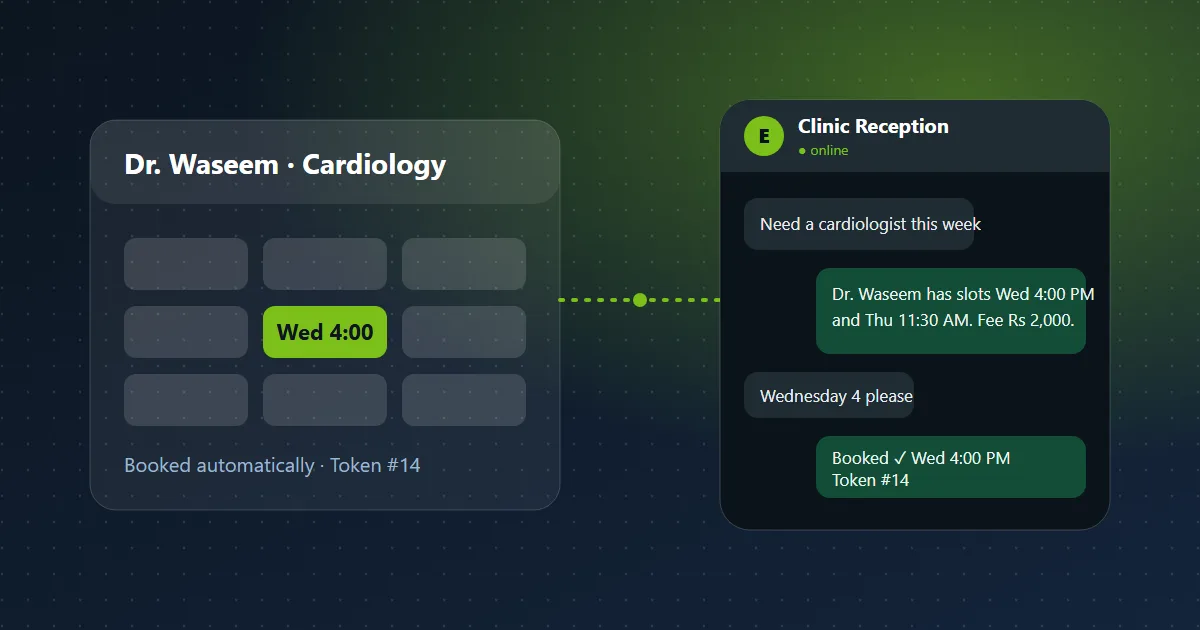
An AI agent on WhatsApp that answers patients in Roman Urdu, Urdu and English. It books, cancels and reschedules appointments by itself, at any hour, and connects to a full hospital management system.
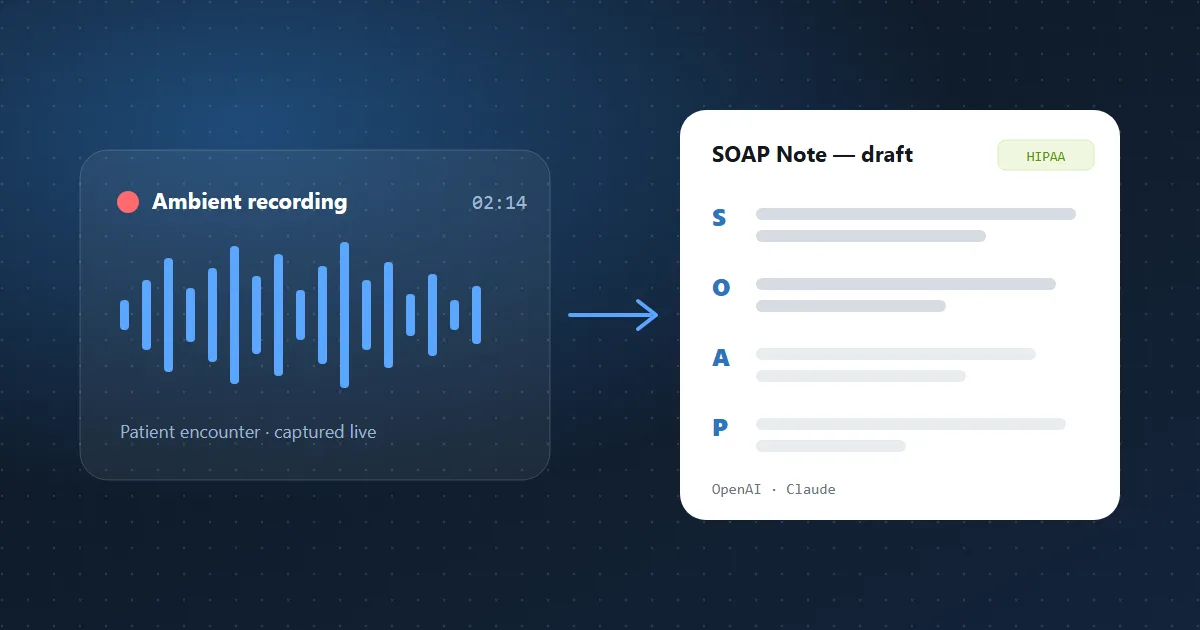
An AI scribe that listens to patient visits and writes clinical notes for the doctor to review. It includes templates, letters, coding support and a full HIPAA compliance programme.
A chatbot answers questions. Agentic AI decides what to do, uses your tools and takes action, such as scheduling a visit or routing a claim, then reports what it did.
Each agent is limited to the actions it needs, and high-risk steps wait for human approval. Anything it is unsure about goes to a person with the conversation attached. Every run is logged step by step, so a mistake can be replayed and fixed.
RAG grounds every answer in your own content: documents chunked and embedded in a vector database, retrieved with hybrid search and re-ranking, with a citation on each answer. If nothing relevant is found, the agent says so.
We run a live agent in Roman Urdu, Urdu and English, including the way people actually type on WhatsApp. The models handle most major languages, and we test on your users' real messages in every build.
Access to the systems the agent will use, through your existing APIs or database. The documents it should answer from. And one person who knows how the task is done today.
Usually a few weeks, because we start with one task and a narrow scope. The first version runs with a person approving the actions. Once the traces show it behaving, we widen what it does on its own.
Two costs. The build depends on how many of your systems the agent touches and how much checking the work needs. Running cost is per run, the model tokens plus hosting: a few cents for a short task, more for long document or research jobs. You get both figures, measured on a test run, before launch.
We pick per project and keep the model layer swappable. We have shipped live systems on OpenAI and Claude models, and build with the OpenAI Agents SDK, LangGraph, Google ADK and MCP servers.
Retrieval and logs stay in infrastructure you control, and the model sees only what a step needs. We can mask sensitive fields first, and run on a provider tier with no training on your data.
Tell us about your AI agent project. We will reply with what we would build first and what it would involve.